4 Characteristics of NPCs to Avoid
Issue #2: The NPC is the Protagonist's worst enemy.

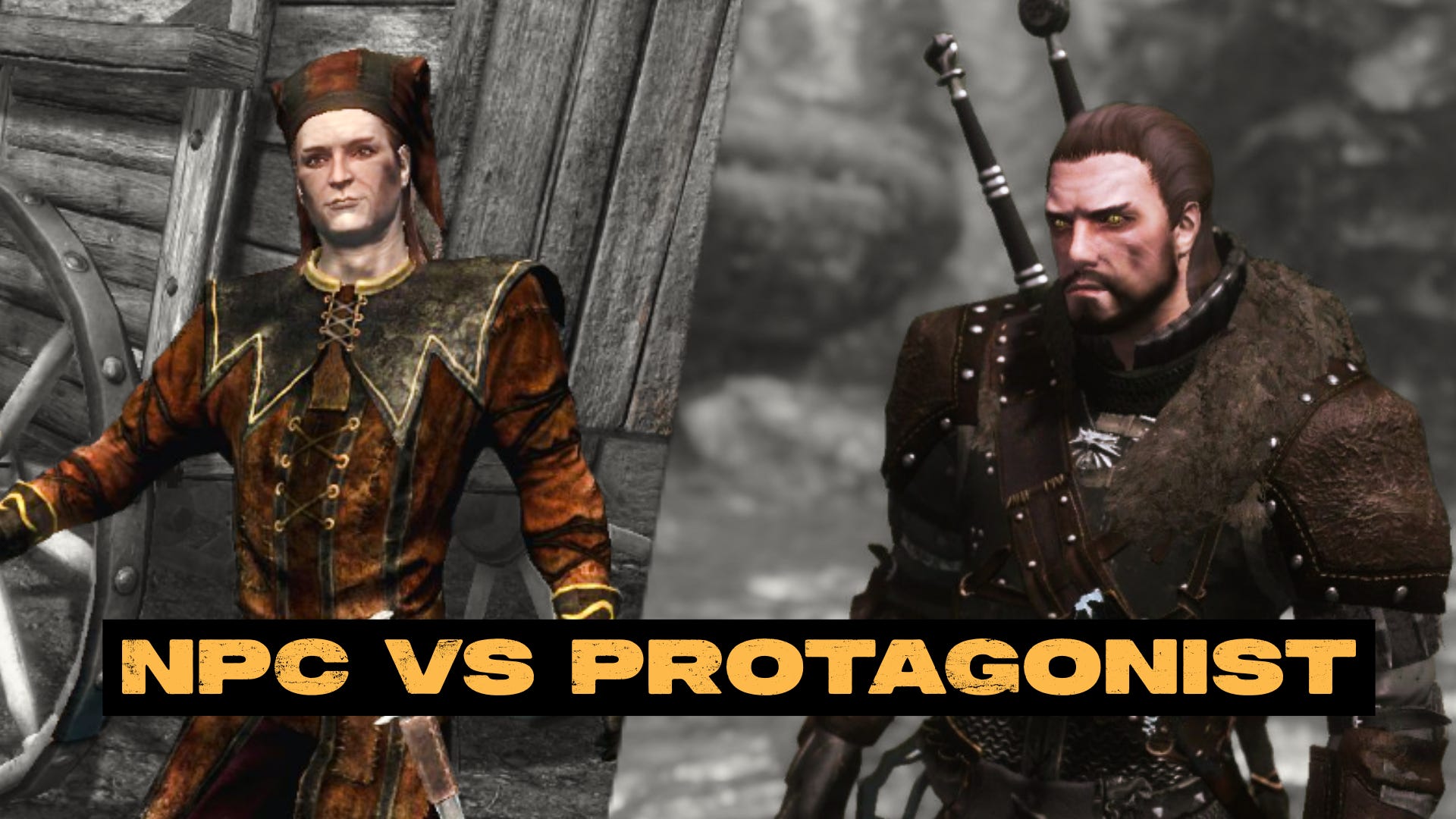
Part of being able to define anything is being able to clearly identify what it is not.
So, for us to be able to know what makes up a Protagonist, we need to know what makes up its arch-nemesis, the NPC.
If you don’t have experience with video games the term NPC may be meaningless to you. But by the end of this post, you’ll have a clear understanding. If you are already familiar with NPCs, you’ll walk away from this issue laughing at how clearly the characteristics of a video game NPC align with living an unfulfilling life.
First up, a brief description for the uninitiated:
What is an NPC?
NPC stands for Non-Player Character. Most commonly thought of in video games, but I recently learned the term was previously used in tabletop roleplaying games like Dungeons and Dragons, but the concept is the same.
In any role-playing game, you play as a certain character, possibly more than one, but that doesn’t mean there is only one character in the game at a time. So, technically, any character that you as the player don’t explicitly control is an NPC.
Usually, NPCs are characters that give you quests to complete, sell you weapons, or maybe they’re townsfolk you need to talk to for information. But NPC’s also include sidekicks and enemies. Again…it’s any character not controlled by you, the player.
And within the past decade the term “NPC” has outgrown the gaming communities and has become a derogatory slang term for someone who either doesn’t think for themselves, or is passively experiencing life instead of actively engaging in it.
Now that that’s covered, I’ve got 4 ways to highlight how the NPC is the arch-enemy of you becoming a Protagonist. Some are obvious, others are nuanced enough that I feel pretty clever having come up with the comparison. 😉
NPCs confuse existing for living
In a game, the NPCs either don’t move from their location (So that you can easily find them), or maybe they will follow the hero around. But the point is they don’t have their own agenda. They’re just hanging out.
They sit or stand in the same place day after day, offering the same conversations or selling the same merchandise to the hero figure. They look as real as the main character in terms of how many pixels went into designing them, but they don’t ever change. They ‘wake up’ and do the same thing every single day and call it a life.
Don’t be fooled into thinking that you’re not the main character just because you don’t already have a shiny suit of armor or you don’t spend all day hunting dragons. Protagonism is not about a specific list of activities that are “hero-worthy”. It’s the mindset. The mindset that is curious about what can be done to improve your life from what it was like yesterday.
Existing = breathing, eating, sleeping, reproducing, etc.
Living = actively making your life more meaningful over time.
NPCs don’t ask the real why.
And at the root of an NPC never changing is the fact that they never ask the real why.
It’s not as simple as saying an NPC doesn’t ask questions. Villains ask questions. Victims ask questions. But it’s the difference between asking “Why is my life so miserable?” or asking “I have been unhappy for a long time. What is my part in feeling so miserable?”
You can ask why in the sense that you literally ask a question that uses the word why, which doesn’t guarantee helpful answers, or you can ask the real why, which involves a curiosity to get to the true root of the issue.
NPC versions of very applicable questions may include:
“Why do I have such a terrible job?”
“Why am I unlucky in love?”
“Why does my life seem so much harder than others?”
The Protagonist version of those same questions would look more like this:
”Why do I hate my job? Do I feel underutilized? Do I not feel listened to? What can I do to improve this? Or if nothing can change here, what skills can I develop to go to a better company?”
“I have standards just like anyone else…are mine too high? Am I living a life worthy of a potential partner’s standards, or am I expecting them to ‘accept me as I am?’”
“What is my definition of a good life? Am I looking at the Instagram version of someone’s life and assuming they don’t have problems? What things do I do that get in the way of my happiness?”
Pretty obvious to spot the differences, right? The Protagonist’s questions involve introspection. They look for personal responsibility and even open up the possibility of needing to redefine what we expect from life.
a non-real why is less about getting answers and more about blowing off steam from feeling unhappy. We may avoid asking the real why because it involves being uncomfortable with the answers. But it is in those uncomfortable answers that the key to improving our situations lies.
NPCs operate in dialogue trees
Sometimes in a video game, characters only have one or two lines to say. In other games they may have a list of different topics or statements and you have to initiate conversations with them multiple times to “exhaust” their “dialogue tree”. But they still have conversational limits.
Are you the kind of person who likes to discuss new and interesting ideas because you’re a curious person? Do you also know people that no matter where the conversation starts, it comes back around to politics, or sports, or neighborhood gossip?
Real-life NPCs tend to not be very open-minded. Because it’s easier to attribute all of your problems to the other side of the political aisle than it is to take responsibility for your part in your misery. Or, you could just talk about inane things that don’t matter because it’s easier to ignore your unhappiness than to face it.
Not expanding your mind through curiosity contributes to a rigidity that keeps you from seeing the opportunities right in front of you to be more fulfilled.
There are people out there who genuinely operate with their own dialogue trees. A handful of topics they can talk about for hours, but anything outside of that makes them feel uncomfortable, makes them shut down, or it might even lead to them trying to make you feel bad for wanting to talk about it.
But a Protagonist is always open to having conversations that they’ve never had if there’s a chance for them to figure out another piece of the puzzle.
An NPC is not coded to be the main character
The other points all make up part of the most important distinction between an NPC and a Protagonist: They are genuinely not wired to be the hero.
This is a meta concept because we’re not talking about the in-game experience. We’re talking about how the actual game designers and developers do not code an NPC to behave like the heroic characters.
They do not have the tools to take control of their life.
An NPC is given just enough code to respond or react. But not to think or evolve.
The playable character has the ability to level up. To learn new things that make playing the game easier to manage. They have the capacity to figure out what they have to do to reach their goal. Hint: it always involves change and struggle on their part.
But an NPC? If they were real people, they may say things like:
“That’s just the way I am.”
“It’s not my fault”
“That’s above my pay grade”
“You don’t know how hard I have it”
These are all types of statements that imply ‘insufficient code’.
They suggest that the speaker does not have the ability to change or grow in order to overcome their situation. So they just accept it…but not without complaining as they go along.
In a way, you can’t blame the NPC too harshly. They are not wired for success. But just because the NPC isn’t currently wired to be a Protagonist doesn’t mean you should settle for anything less than breaking free from living small like a non-player character.
Breaking free from being an NPC
Do you identify partially or largely with these definitions of an NPC?
Well, I’ve got good news for you.
You don’t need a computer programmer to write the new code for you.
You can do it yourself. Like Neo breaking out of the Matrix for the first time, simply becoming aware of your limitations is the first step.
Catching yourself whenever you ask a “why” question instead of the “real why”.
Pausing when you realize you are resorting to your “dialogue tree” topics.
Challenging yourself when you notice how you shrug off the call of the Protagonist with lines like “It is what it is” or “that’s just my personality”.
These are the first steps for evolving from a non-player character to becoming the hero in your own life.
Why doesn’t everyone do it?
We’ve already touched on it at the top of this issue.
The reason people stick with their NPC identity over metamorphosing into their own beautiful Protagonist is because it is uncomfortable. Notice I didn’t say hard. Everyone knows it’s hard. But I think the most difficult part is accepting that you are more to blame for your current sadness than anyone.
Everyone has external circumstances. Everyone has very real things happen that cause sadness and setbacks. Some more devastating than others. But there are people far more humble than you that live joyfully, and there are people with all the external indicators of success that hate their lives.
Stop assuming that a good life depends on a baseline of universal metrics for fairness.
A good life depends on you being aware of how you get in the way of your own ‘living’.
Because remember: Living = actively making your life more meaningful over time.
The difference between a real-life Protagonist and an NPC is not a matter of fate. It’s a matter of consciousness. Time to start thinking like a main character.
Sincerely,
Jameson, Protagonist in Training.
p.s. if you’re not coming to this substack from my podcast, you should check out Becoming The Main Character. I give you summarized (but still detailed) narrative versions of the greatest fiction ever written. Almost like I’m telling you the story around a campfire. Each episode is a practical application of Protagonism where we examine how the choices the characters make lead to their success or demise. I’ve done classics including Moby Dick, Macbeth, Little Women, 1984, and I just finished the complete Lord of the Rings trilogy. Check it out:
BTMC on Spotify:
BTMC on Apple Podcasts: